
Comparing Cardano vs Solana is quite interesting since they are two of the largest proof-of-stake (PoS) blockchains. Their main distinctions lie in their consensus mechanisms and performance. Solana is quicker and more developer-friendly than Cardano, although it has experienced multiple network outages.
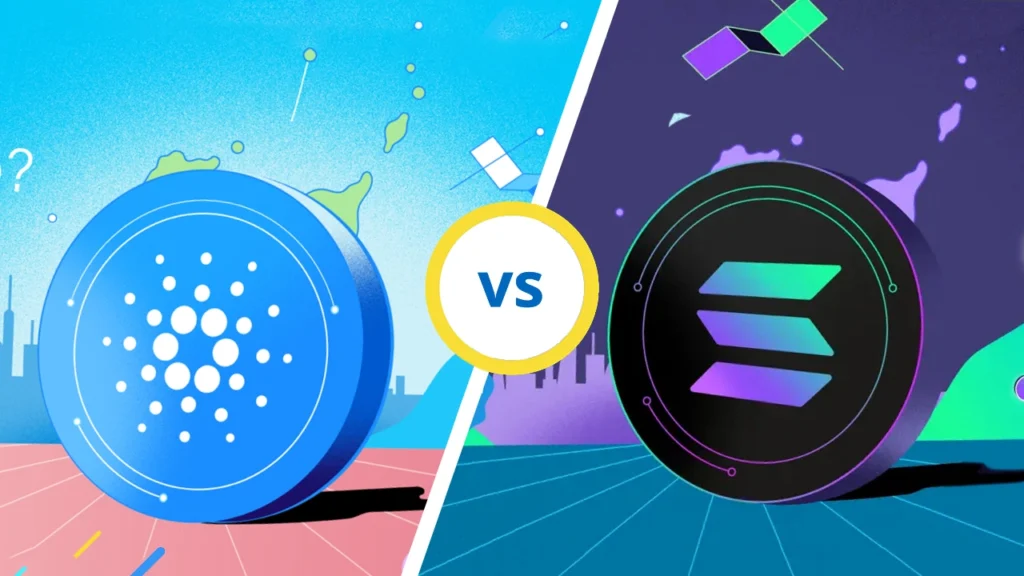
Cardano’s native coin is ADA, and Solana is powered by SOL. Solana will still be the better choice in 2025 due to its higher performance and wider ecosystem. Solana’s supremacy is also seen in its market capitalisation, which is three times that of Cardano.
Cardano and Solana aim to be quicker and more scalable than Ethereum. However, they have yet to outperform Ethereum in terms of acceptance.
In this post, we will compare Cardano and Solana to help you understand how they differ and whether one may be a better option this year.
The Fundamentals of Cardano and Solana
Cardano
Think of Cardano as a careful, geeky genius who enjoys doing their studies. Cardano, founded by Ethereum co-founder Charles Hoskinson, is based on academic research and takes a peer-reviewed approach. The blockchain project is driven by a Proof of Stake (PoS) consensus algorithm mechanism, as well as Plutus, its smart contract platform. Cardano features its own currency, ADA, which is used for staking, petrol fees, and governance on the network.
Solana
On the other hand, Solana is a high-achieving racer who is obsessed with speed and smashing records. Solana’s high-performance scalability is achieved using a combination of Proof of History (PoH) and PoS, resulting in lightning-fast transaction processing. Anatoly Yakovenko, the company’s founder, envisioned a blockchain capable of supporting a global-scale decentralised application (dApp) ecosystem without difficulty. Solana has a native token called SOL.
Head-to-Head Comparison: Cardano vs Solana
Speed and Scalability
Solana’s main selling point is its incredible speed, which can handle up to 65,000 transactions per second. Cardano, on the other hand, promotes moderate growth and does not aim for the same rapid speed as Solana. If you value fast and rapid transactions, Solana may be a better option.
Decentralisation and Security
Cardano prioritises decentralisation and stringent security protocols in blockchain technology. Similarly, Solana is a distributed ecosystem that relies on centralised nodes to maintain its speed. However, Cardano outperforms Solana in terms of decentralisation.
Developer Ecosystem
Cardano’s entrance hurdle for developers may appear high, but it has gotten more hospitable with the Alonzo upgrade. Solana, on the other hand, is more approachable, and its thriving ecosystem has resulted in an increasing number of DeFi projects and DApps.
Cost Efficiency
Both blockchains have minimal transaction costs, but Solana may take the lead because its rapid speed adds significantly to its cost-effectiveness. This is not to suggest that Cardano is expensive, but it works at a far slower rate than Solana, making it unable to compete on that scale.
Use Cases of Cardano and Solana in DeFi
Cardano
Although Cardano has a small market share in the DeFi space compared to Solana, the project has concentrated on developing secure and scalable financial tools for consumers who value reliability. Some of these efforts include MuesliSwap and SundaeSwap.
Solana
Solana is already a vibrant hub for DeFi projects. It contains high-performance applications that require real-time transactions. Its most popular initiatives include Serum, Raydium, Jupiter, and Mango Markets.
Community and Market Performance
Cardano’s community is strongly dedicated and known to be among the most engaged in blockchain. Solana’s community, fuelled by strong performance numbers, is equally excited. Both systems have high market penetration, but Solana’s quick surge has made headlines, whilst Cardano’s methodical approach appeals to cautious investors.
However, they are not without controversies. Solana’s Achilles heel? Has to be network outages. While its speed is outstanding, the frequent outages have prompted concerns. On the other side, Cardano has been chastised for its poor development rate. While its emphasis on quality over quantity is praiseworthy, it has tried the patience of its shareholders.
Frequently Asked Questions
Should I invest in Solana or Cardano?
This is not a decision you should take lightly. Both coins are excellent, but you must decide what type of investment you want to make. Solana is ideal for people who value speed, with an active and flourishing developer and investment community.
Meanwhile, Cardano is a slow burner, with a focus on true decentralisation and security. It does not move as quickly as Solana, but it provides a more stable and reliable ecosystem. So, based on this brief summary of both coins, you should conduct additional research and proceed in the way that best suits you.
Which coin is better than Solana?
This answer is very dependent on your criteria for determining a better-performing coin. Cardano, for example, is frequently compared to Solana, with many people praising it for its more careful approach and scalability.
Some investors may be drawn to Cardano’s tight dedication to decentralisation and security, but others may prefer Solana’s faster speeds. It all comes down to what you value in a currency, so if Solana’s unique selling characteristics do not appeal to you, you may want to look into other possibilities as Cardano.
Does Cardano have a future?
Cardano has a promising future, according to experts and research. It is regarded as a coin with compelling use cases and a flourishing community. It is devoted to creating a dependable, scalable, and entirely decentralised environment.
Is Cardano more secure than Solana?
Cardano may be more secure than Solana because it is a genuinely distributed environment. Meanwhile, Solana relies on some centralised nodes to maintain its speed. Solana is also more prone to network disruptions, and the frequent downtimes have not been well-accepted.
Wrapping Up
Based on the foregoing, which is the better bet for DeFi? The answer depends on your priorities. Solana is your best bet if you want lightning-fast transactions and a thriving environment. However, if decentralisation, security, and long-term stability are important to you, Cardano is worth the wait.
DeFi is a fascinating subject, and choosing the appropriate coin to travel through is critical. If you’re still unsure, you could conduct an additional study and possibly experiment with both currencies to discover which one works better. Good luck!