
Whether you are an active trader, a DeFi participant earning yield, or a project team preparing a token launch, we will explain what a crypto liquidity provider is, how crypto liquidity providers earn fees, where those fees come from, and what risks to understand before participating.
Liquidity is the backbone of crypto markets. Every trade on an exchange, centralised or decentralised, relies on liquidity providers (LPs) to function efficiently. In return for supplying this liquidity, LPs earn fees that can become a steady source of passive income when managed correctly.
What Is a Liquidity Provider in Crypto?
A liquidity provider is an individual or entity that supplies crypto assets to a trading venue so others can buy and sell without large price swings. Liquidity providers exist in two main environments:
- Centralised exchanges (CEXs) such as Binance, Kraken, and OKX
- Decentralised exchanges (DEXs) such as Uniswap, Curve, PancakeSwap, and Balancer
In both cases, LPs reduce slippage, improve price discovery, and enable faster execution for traders.
How Liquidity Providers Earn Fees
Liquidity providers earn fees whenever trades occur against the liquidity they supply. The mechanics differ slightly between centralised and decentralised platforms.
Liquidity Provider Fees on Decentralised Exchanges (DEXs)
1. Trading Fees from Automated Market Makers (AMMs)
Most DEXs use automated market makers (AMMs) instead of order books. Users trade against liquidity pools rather than directly with other traders.
Each trade incurs a fee, typically between 0.01% and 0.30%, that is distributed proportionally to liquidity providers in that pool.
Example:
- A Uniswap ETH/USDC pool charges a 0.30% fee
- A trader swaps $10,000 worth of ETH
- $30 is collected as fees
- LPs receive $30 based on their share of the pool
The more volume a pool processes, the more fees LPs earn.
2. Fee Tiers and Dynamic Fees
Some platforms offer multiple fee tiers depending on volatility and liquidity depth:
- Uniswap v3 allows LPs to choose fee tiers (0.05%, 0.30%, 1.00%)
- Curve uses lower fees optimised for stablecoin pairs
- Balancer supports custom fee structures per pool
Higher fees can mean higher returns, but they often go hand in hand with higher volatility and risk.
3. Concentrated Liquidity (Advanced LP Strategies)
Modern AMMs allow LPs to provide liquidity within specific price ranges. This improves capital efficiency and fee generation but requires active management.
Benefits:
- Higher fee income per dollar deployed
- Greater control over exposure
Risks:
- Requires monitoring and rebalancing
- Increased risk of being pushed out of range during volatility
Liquidity Provider Fees on Centralised Exchanges
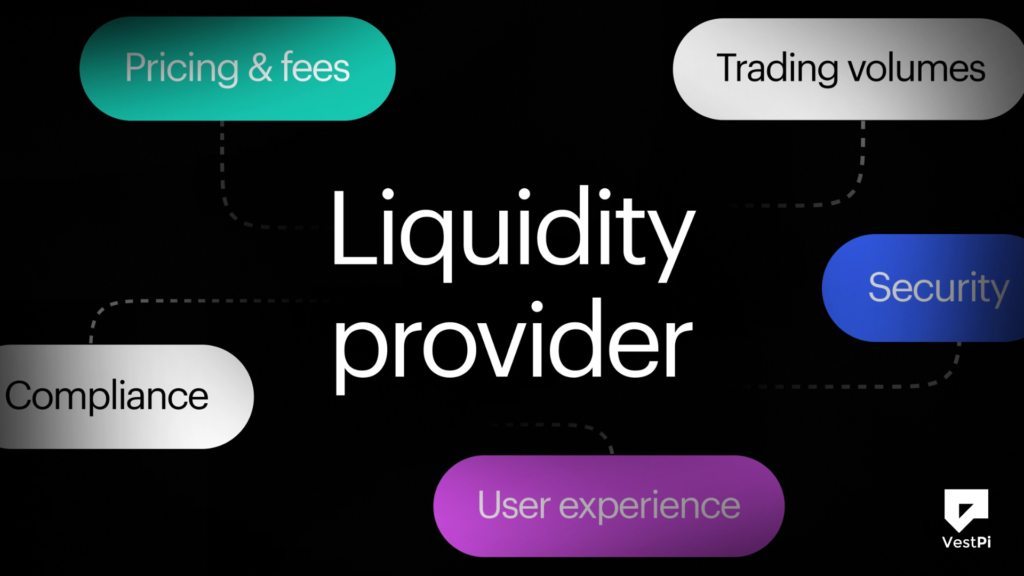
On centralised exchanges, liquidity providers typically earn fees in a different way.
1. Maker Fees and Rebates
CEXs operate using order books. Liquidity providers place limit orders that sit on the book until matched.
- Makers add liquidity and often pay lower fees
- Some exchanges offer maker rebates, paying LPs a small percentage per filled order
High-frequency traders and professional market makers often dominate this space.
2. Market Making Programs
Some exchanges offer formal liquidity provision or market-making programs:
- Reduced or zero trading fees
- Rebates based on volume
- Preferential API access
These programs are usually designed for institutional or advanced traders with significant capital.
Additional Revenue Streams for Liquidity Providers
Liquidity providers may also earn additional rewards beyond trading fees:
1. Liquidity Mining Incentives
Some protocols distribute governance tokens to LPs as an incentive to bootstrap liquidity.
- Rewards are separate from trading fees
- Can significantly increase APY during early stages
- Often temporary and subject to dilution
2. Yield Compounding Strategies
LP tokens can sometimes be staked or reinvested:
- LP tokens staked in farms
- Auto-compounding vaults
- Strategy-based DeFi protocols
These strategies increase complexity but can enhance long-term returns.
Key Risks Liquidity Providers Must Understand
Liquidity provision is not risk-free.
1. Impermanent Loss
When asset prices move significantly, LPs may end up with less value than if they had simply held the assets. Fees can offset impermanent loss, but not always.
2. Smart Contract Risk
DEXs rely on smart contracts. Bugs, exploits, or protocol failures can result in partial or total loss of funds.
3. Volatility Risk
High volatility can reduce LP profitability, especially in non-stablecoin pools.
4. Opportunity Cost
Capital locked in pools cannot be deployed elsewhere unless withdrawn.
How to Evaluate Liquidity Pool Profitability
Before becoming a liquidity provider, consider:
- Daily trading volume
- Historical fee generation
- Pool size and depth
- Asset correlation (stable vs volatile pairs)
- Incentives vs sustainability
High APYs often reflect higher risk rather than guaranteed income.
Who Should Consider Becoming a Liquidity Provider?
Liquidity provision is best suited for long-term crypto holders seeking yield, users comfortable with DeFi mechanics, investors who understand volatility and risk, and traders looking to monetise idle assets. It is less suitable for short-term traders or those unfamiliar with on-chain risk.
Final Thoughts
Liquidity providers play a foundational role in crypto markets. In return, they earn fees that can generate meaningful passive income when deployed thoughtfully.
However, fee income should never be viewed in isolation. Successful liquidity provision balances volume, fees, volatility, and risk management.
Understanding where fees come from and what can erode them is the difference between sustainable yield and avoidable loss.