
Understanding what testnets are, how to use testnets, and why they are important is vital for anyone involved in the crypto space. This post examines the idea of testnets, their importance, and how they are essential to the creation and secure functioning of cryptocurrency wallets and other blockchain-based apps.

Testnets are crypto’s unsung heroes. Every time a new blockchain, cryptocurrency, or dApp goes online, it’s almost certain that it’s already been running for months on a test network.
Testnets safeguard the Bitcoin ecosystem and reveal hidden weaknesses like a dark vigilante. Many individuals are unaware of the numerous advantages of utilizing and investigating testnets, even if you’re not a developer.
What are Testnets?
A testnet is a low-risk, worthless sandbox environment that resembles a main network. Before implementing their protocols and decentralized apps on a mainnet or live blockchain, blockchain technologists and smart contract developers test them on testnets.
All coins and tokens have no value because a testnet is a different ledger from its main network. Testnet Bitcoin should always be worth zero, regardless of the market price of Bitcoin (BTC). Consequently, on a testnet, all transaction fees are practically free.
For DeFi developers working on networks like Ethereum (ETH), which are notorious for their high gas costs, this is crucial. Developers can transmit thousands of transactions—which would often cost tens of thousands of dollars—for free on the Ethereum testnet.
What Is the Purpose of Test Networks?
A testnet’s primary function is to track contracts and apps in an unrestricted setting. In addition to helping developers make sure their apps function properly, this also helps reveal security flaws and possible problems.
In the cryptocurrency industry, cybersecurity attacks are frequent, and the on-chain realm of DeFi and NFTs is especially dangerous. Before contracts are released on the mainnet, where an exploit might cost developers and consumers like you and me millions of dollars, white-hat hackers and security auditors utilize blockchain testnets to identify any flaws.
A major network like Ethereum or XRP might have catastrophic consequences if it fails. Therefore, in order to make mistakes and safely break things before the public utilizes them, developers want a safe, worthless environment.
Testnets are essential to the growth and development of the blockchain and cryptocurrency ecosystem. Before new technologies and applications are implemented on mainnets, testnets serve as a crucial basis for innovation, security, and dependability. The following explains the significance of testnets:
1. Safe Environment for Experimentation
Testnets provide a controlled, risk-free environment in which developers can experiment with new ideas, features, and technologies.
This isolation from the mainnet allows for the testing and development of various components of blockchain applications without affecting real-world operations. Testnets encourage innovation and the continuing evolution of blockchain technology.
2. Bug Detection and Security Testing
Ensuring the security and stability of blockchain applications is critical. Testnets are critical in finding and resolving bugs, vulnerabilities, and other issues before a project goes online.
Pre-deployment testing helps to ensure the main network’s integrity and security. Smart contracts, self-executing contracts containing coded terms, can be carefully evaluated on testnets to confirm their functionality and avoid exploitable weaknesses.
3. Realistic Testing Conditions
Developers can test how their apps will function in real-world scenarios by using testnets, which offer a realistic simulation of the mainnet environment.
Testing user interactions, network behavior, and transaction processing are all included in this. Testnets assist developers in optimizing performance and ensuring that their applications can manage anticipated loads and possible stress scenarios by replicating real-world conditions.
4. Facilitating Network Upgrades
Major updates and improvements to blockchain networks have inherent dangers. If these changes are not thoroughly vetted before being implemented on the mainnet, they may cause disruptions or failures.
Testnets allow developers to extensively test and validate network upgrades in a controlled environment, lowering the risk of errors when they are sent to the mainnet. This includes evaluating new consensus mechanisms, improving transaction processing, and making other key modifications.
5. Community and Ecosystem Engagement
Testnets are also vital for engaging the larger community and ecosystem. They let developers, testers, and users communicate, experiment, and provide feedback.
The collaborative method assists in identifying difficulties, gathering varied opinions, and improving the overall quality of blockchain applications. Community engagement using testnets leads to a more inclusive and collaborative development process.
6. Cost Efficiency
Testing on a testnet is less expensive than testing on the mainnet since it employs valueless tokens, removing the financial risk. This cost-effectiveness promotes more comprehensive testing and experimentation, resulting in higher-quality applications and innovations.
Developers can deploy numerous iterations of their projects on testnets without incurring large fees, guaranteeing that the final result is thoroughly tested and optimized.
Mainnets Vs Testnets
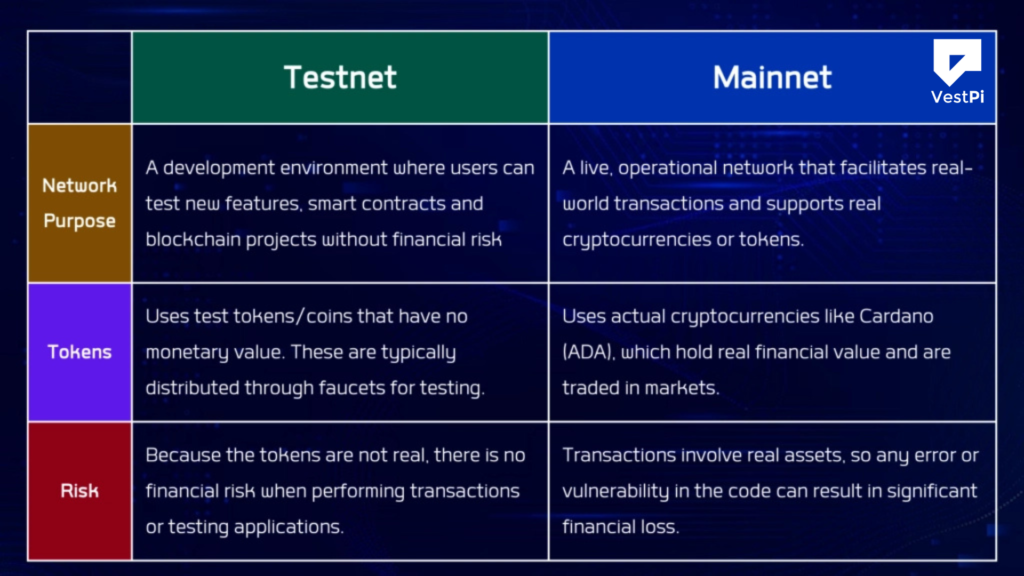
Mainnets and testnets are both blockchain networks, but have distinct uses and functions. Here are a few important differences:
- Purpose: The mainnet facilitates real-world transactions and processes involving actual value exchange. A testnet is intended solely for testing and development.
- Currency: Mainnet currencies and tokens have economic worth. Bitcoin and Ethereum can be exchanged, spent, and invested on their respective mainnets. On a testnet, tokens have no monetary value and are frequently freely distributed by faucets. A testnet faucet provides web3 developers with a small number of free testing tokens to help them deploy, test, and optimize smart contracts.
- Risk: Transactions on the mainnet pose significant risks, including cash loss and security breaches. Testnets offer a risk-free environment in which developers can securely run tests.
- Stability: Mainnets are robust and secure networks that can support real-world transactions and applications. Testnets may be less stable since they are frequently used to evaluate new and untested code.
How to Enable Testnets in the Trust Wallet Browser Extension
It’s simple to enable testnets via the Trust Wallet browser extension. To access and utilize testnets for secure experimentation and development, follow these steps:
- Open the TrustWallet Browser Extension: On your selected web browser, open the Trust Wallet browser extension.
- Navigate to Settings: Select the settings icon, which is usually found at the bottom of the TrustWallet screen.
- Select Developer Settings: Scroll down the settings menu and choose “Developer Settings.”
- Turn on Testnets: Locate the “Enable Testnets” option in the Developer Settings and turn it on.
- Access the Testnet: Return to the main settings menu after testnets have been activated.
- Select Networks: From the settings menu, choose “Networks.”
- Choose the selected Testnet: To activate the selected testnet, scroll all the way down the Networks list and choose it.
Do Testnet Coins Have Any Value?
Concerning testnet coins, things aren’t always clear-cut. To pay “transaction fees” on the testnet, developers still require testnet tokens like Goerli Ethereum (gETH). This indicates that developers testing decentralized applications still have some demand for them.
Faucets, or free websites that “drip” little amounts of test bitcoin into a testnet wallet, are where testnet coins are gathered. These faucets really deplete their supply of testnet coins during times of strong demand, making them a valuable commodity on the cryptocurrency market. gETH was trading at more than $1 for a short while.
Take Home
In conclusion, testnets are an essential component of the cryptocurrency and blockchain ecosystem because they offer a secure and regulated setting where developers may test, experiment, and improve their applications before deploying them on mainnets.