Are you curious about how to buy crypto anonymously? Many people are searching for safer, more private ways to purchase Bitcoin as KYC regulations become more stringent. Fortunately, there are safe ways to accomplish this.
Although the public blockchain records transactions more clearly than cash or even banks, Bitcoin is known for being anonymous. As a result, purchasing Bitcoin anonymously might be surprisingly challenging.
In this post, we’ll explore two practical methods to buy crypto with no ID requirements — namely: mining, no-KYC exchanges, P2P platforms, prepaid cards, and Bitcoin ATMs, and privacy coins — we’ll compare their pros and cons alongside their anonymity levels.
How To Buy Bitcoin Anonymously 2026
How can you buy Bitcoin anonymously without KYC? To begin, you must first set up a self-custody wallet where you’ll store your Bitcoin.
Since non-custodial wallets only keep your private key and not your identification, they are technically anonymous. Blockchain transactions will show an address rather than your identity, so you won’t be identified until someone can connect you to that particular address.
With non-custodial wallets, you have complete control over your money and don’t have to rely on a third party. Mobile apps like BlueWallet or Sparrow, as well as hardware wallets like Ledger and Trezor, are popular choices.
The next stage is to obtain Bitcoin without revealing your identity once your wallet is prepared. Due to stricter KYC enforcement on some of the most well-known exchanges and growing international rules, this is where things become complicated.
These are our initial list of anonymous ways to purchase Bitcoin. Keep in mind that achieving complete anonymity is extremely challenging and unattainable for the majority of people. Different amounts of anonymity are possible with each method.
1. Use a No KYC Swap Platform
You can purchase cryptocurrency without ID verification on sites like StealthEX, Changelly, and others (though there may be certain amount restrictions). Without creating an account or providing personal documentation, these services usually function by letting users enter the cryptocurrency or money they wish to exchange for a different coin.
They can typically be funded with cryptocurrency or prepaid vouchers, which can then be exchanged for Bitcoin without requiring KYC. Some of these platforms have put in place some kind of KYC due to the tightening regulations surrounding cryptocurrency. Let’s take a brief look at how to purchase Bitcoin via a site such as StealthEX:
- Choose the “Buy” option first, then input your Bitcoin address, select a payment method, and then select the type and amount of fiat. The address of Satoshi Nakamoto is used in the example below.
- Next, make sure the information is accurate.
- Next, accept the platform’s terms of service and privacy statement.
- Lastly, complete the transaction by entering your credit card information.
In order to balance supply and demand, decentralized cryptocurrency exchanges route deals among liquidity pools and automated market makers. You’ll enter your wallet address, send a specific coin (like Monero or Ethereum), and receive BTC in return. The process is convenient because there are no ID checks, but there is a price.
Be advised that, compared to centralized cryptocurrency exchanges, fees and slippage are higher. You’ll want to examine each platform’s restrictions and supported locations. Nevertheless, they provide quick, confidential transactions without disclosing your true identity. Keep in mind that before utilizing these exchanges, you must first convert funds into a privacy-friendly coin if you’re starting with fiat.
2. Use a Bitcoin ATM
In order to balance supply and demand, decentralized cryptocurrency exchanges route deals among liquidity pools and automated market makers. You’ll enter your wallet address, send a specific coin (like Monero or Ethereum), and receive BTC in return. The process is convenient because there are no ID checks, but there is a price.
Be advised that compared to centralized cryptocurrency exchanges, fees and slippage are higher. You’ll want to examine each platform’s restrictions and supported locations. Nevertheless, they provide quick, confidential transactions without disclosing your true identity. Keep in mind that before utilizing these exchanges, you must first convert funds into a privacy-friendly coin if you’re starting with fiat.
There are a few significant drawbacks, though. Depending on the operator, network congestion, and demand, bitcoin ATM fees might vary from 6 to 10%. Additionally, even for little amounts, more ATMs are starting to require biometric scans or phone verification. You can utilize services like CoinATMRadar to find a machine that permits anonymous use.
Avoid ATMs that need an ID scan and always check the machine’s KYC policy beforehand. This is still one of the easiest ways to purchase Bitcoin secretly with cash if done correctly.
3. Use Peer‑to‑Peer Platforms
You can exchange cash or other assets for Bitcoin on peer-to-peer marketplaces like Bisq, Paxful, and others. Because transactions with Bisq rely on escrow smart contracts, decentralized order books, and secure communication channels, neither an account nor an identity verification are required. It’s a truly decentralized exchange with privacy integrated in.
For Bisq, download the Bisq desktop software, connect it to your wallet, and then trade with others immediately. Because the platform employs multi-signature escrow, neither party can embezzle money before the trade is finalized. To deter fraud, security deposits are necessary.
Additionally, Bitcoin can be exchanged for prepaid gift cards, bank deposits, PayPal transfers, or even in-person cash transactions using Paxful and related sites. Many merchants do not require identification for trades under a specific amount.
Meanwhile, on these sites, trust is more important. Before making a choice, you should check the vendor’s reputation and take extra safety measures.
It’s also important to note that local laws need to be taken into account because certain governments are targeting P2P transactions. Peer-to-peer, however, is perhaps the most adaptable way to buy Bitcoin anonymously.
4. Buy Privacy Coins and Swap for Bitcoin
You can exchange your existing, more private coins for Bitcoin via platforms or decentralized cryptocurrency bridges, such as Monero (XMR), Zcash (ZEC), and others.
Since it is harder to determine where your money came from, this method provides an additional degree of secrecy. You may purchase Monero via mining or peer-to-peer transactions, transfer it via a chain with improved secrecy, and then convert it to Bitcoin.
But keep in mind that your transaction appears on the public blockchain as soon as you rejoin the Bitcoin network. Don’t transmit Bitcoin straight to centralized exchanges or reuse addresses if you value long-term privacy. Compared to using only fiat-based approaches, using privacy coins in conjunction with decentralized swaps offers substantially greater anonymity.
5. Mine the BTC Yourself
Mining Bitcoin is another way to be anonymous, even if it’s not actually purchasing it directly. This approach completely circumvents KYC and eliminates the need to communicate with outside parties. Nevertheless, there are significant up-front expenses associated with mining, such as buying an ASIC miner, installing adequate electrical and ventilation systems, and maintaining firmware and software.
Although participating in mining pools might increase accessibility and crypto mining profitability, many pools require registration, tracking IP addresses, or implementing KYC, all of which may jeopardize your privacy.
It may take a while to see a return on the initial costs of mining hardware, and mining Bitcoin takes technical expertise. Nevertheless, in the interest of anonymity, it’s still a viable alternative.
| Hardware and energy costs require tech know-how, may expose ID/location | Anonymity Level | Pros | Cons |
|---|---|---|---|
| Mining | Medium-High | No KYC, BTC sent directly to your non-custodial wallet | Requires multiple steps, BTC becomes traceable after the swap |
| No-KYC Exchanges (i.e., Uniswap) | Medium (Pseudonymous; blockchain traceable) | — Quick and simple onboarding — Low fees — Security by design | — Some countries restrict access due to AML regulations — In the EU, MiCA bans no-ID buys on licensed CASPs, but non-custodial wallets remain viable |
| P2P Platforms (i.e., Bisq) | High (Direct, cash-friendly) — but pseudonymous | Full control and privacy, Multiple payment options | Risk of scams, Regulatory pressure |
| Prepaid Cards (i.e., Visa) | Medium-High (depends on how you use the card, and whether it’s loaded with cash) | — Easy to get and use if available in your country — Convenient for small and frequent crypto transactions | — Limited spending amounts — Higher transaction fees — Not universally available |
| Bitcoin ATMs | Low-Medium (Phone/ID often required) | — No need for online registration — Quick and convenient | — High fees and withdrawal limits — Availability varies by region — Risk of getting scammed |
| Privacy Coins | Very High | Strong privacy, Avoids fiat on-ramp | Requires multiple steps, BTC becomes traceable after swap |
Best Wallet Guide for Buying Crypto Anonymously
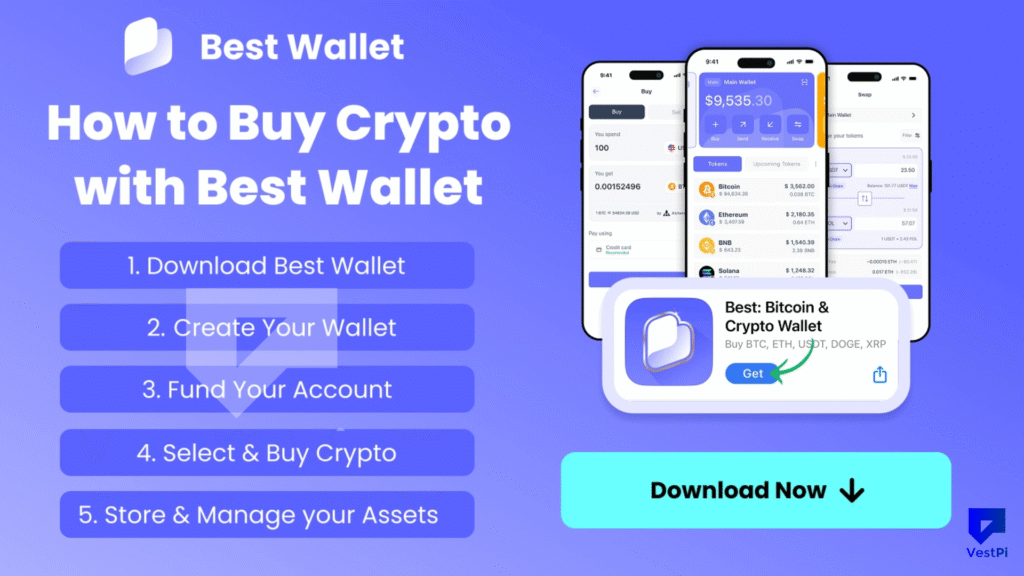
Although you have a number of options, Best Wallet is an additional StealthEX substitute. Here’s a thorough step-by-step tutorial on how to accomplish that.
1. Download Best Wallet on Your Mobile Device
Navigate to Best Wallet website. Click “Download Best Wallet” after visiting the website, then use your phone to scan the QR code displayed on the screen.
2. Set Up Your Wallet
To create your account, follow the app’s instructions. To lock your account, all you need is an email address and a password.
Don’t provide an email that identifies you if you want to remain as anonymous as possible.
3. Top Up Your Wallet
Transfer some money to the wallet after you’re ready. Make sure you have enough money to cover any network fees as well as the quantity of cryptocurrency you wish to purchase. As little as $0.000001 BTC can be purchased.
4. Buy $BTC
Navigate to the Best Wallet dashboard, select Bitcoin ($BTC), then click “Buy.” Select your payment type and network (BTC or WBTC on Ethereum).
Using a credit card to purchase Bitcoin may lessen the transaction’s privacy. Use cash at a peer-to-peer trade to enhance anonymity. You can then take cryptocurrency out of Best Wallet right away. Prepaid cards can also be used directly on Best Wallet.
After that, just use the app to confirm the transaction. Your Best Wallet account now contains your cryptocurrency. It can be stored there or traded, sold, or exchanged.
Why Buy Bitcoin Without an ID?
Since the cryptocurrency market is intrinsically risky due to its susceptibility to fraud and hacking, many investors prefer to purchase cryptocurrency without presenting identification. However, there are additional factors that contribute to the preference for anonymous cryptocurrency purchases. Here is a brief summary of the primary ones:
- Protection of privacy: Investors desire to be shielded from surveillance, primarily to prevent them from disclosing their personal information to governments and banks. Preventing this is getting harder and harder.
- Data breach risks: Centralized exchanges (CEXs) are susceptible to leaks or cyberattacks. Because users store money in their own wallets, using decentralized exchanges (DEXs) lowers that risk.
- Regulatory concerns: Purchasing cryptocurrency anonymously enables investors to securely access digital assets in some jurisdictions (Russia and India are only two examples).
- Financial independence: Banks are strengthening their regulations because they are concerned about cryptocurrency. Investors can choose whether or not to rely on financial institutions and regulators to approve their transactions, thanks to anonymous transactions.
No-KYC purchases are getting more and more worthwhile to consider, but they are also more difficult to accomplish because of the increased global attention around all things bitcoin. This is because large banks may refuse to cooperate with you if they think your earnings are from cryptocurrency.
The Cons of Buying Bitcoin Anonymously?
There are significant trade-offs, even while financial independence and privacy are strong arguments for purchasing Bitcoin anonymously. The following are some of the primary disadvantages of buying cryptocurrency without KYC:
- Increased costs: Bitcoin ATMs and no-KYC exchanges, for instance, frequently have higher fees.
- Scam risks: Since there are few means to hold unregulated exchanges and P2P platforms accountable, you are not shielded from the potential for fraud and frauds.
- Limited purchase amounts: For AML purposes, a number of anonymous cryptocurrency buying methods include a cap on the quantity you can acquire.
- Insufficient liquidity: The trading volume of major CEXs may be higher than that of many smaller, privacy-focused platforms that permit no-KYC purchases.
- No possibilities for recovery: Without a verified account, recovering lost or stolen cryptocurrency is very impossible in the event of an emergency.
- Freeze risk: According to AML regulations, moving anonymous cryptocurrency to KYC-required exchanges (like Binance) may result in account freezes.
Can You Actually Buy Bitcoin With No KYC?
Yes, it is feasible, but it is not an easy procedure because of the extensive AML and KYC requirements (such as the FATF Travel Rule) that are being implemented worldwide to monitor cryptocurrency activity:
What is Anti-Money Laundering, or AML?— This relates to the rules and legislation that prohibit individuals from converting cryptocurrencies that they have obtained illegally into cash.
What about Know Your Customer, or KYC?— This is the verification process that platforms (like CEXs) employ to gather your personal information, including your ID, in order to guarantee adherence to financial legislation. It is a component of AML protocols.
In order to prevent fraud and other illicit actions that eventually affect your privacy, several of the largest cryptocurrency platforms available today, such as Binance, have strict AML and KYC standards in place.
Regulations like this could, regrettably, make your attempts at anonymity useless in the future as regulators in big nations, including the US (i.e., FinCEN), aim to completely eradicate no-KYC.
Understanding the Different Levels of Anonymity
As we’ve shown, purchasing Bitcoin anonymously isn’t as simple as that; depending on the approach or methods employed, there are multiple levels (or a spectrum) of anonymity.
- KYC: Using exchanges that demand KYC or reusing addresses would provide you the least privacy (this allows anyone to cluster your activity and deduce ownership). This ties all future purchases to a single person, even if you made the purchase anonymously.
- High anonymity: Since you can trade without presenting identification, using a non-custodial wallet (like Best Wallet) and a no-KYC exchange can provide a high level of privacy. However, because blockchains are designed to be pseudonymous, wallet addresses and transaction traces are nonetheless kept.
- Full anonymity: Complete anonymity is still achievable in some areas, but it needs a lot of work and usually involves a combination of (riskier) techniques like mixers and illicit ATMs. This is not something we advise doing.
Using a no-KYC exchange and a non-custodial wallet are two of the safest ways to achieve great anonymity. It is important to reiterate, though, that transactions may be linked and trends can be identified because each transaction’s address is documented on a public ledger.
Is Absolute Anonymity Possible?
Although you can purchase cryptocurrency without KYC, most individuals cannot purchase $BTC in complete anonymity. You would need to be in charge of every facet of the transaction that could be connected to you in order to accomplish it. In other words:
- Using a VPN to mask your IP.
- Using a VPN to mask your IP.
- Steer clear of any transactions that call for KYC, and
- Ensuring that the transaction cannot be linked to any of your prior transactions and does not disclose any personal information about you.
Tools like mixers (like CoinJoin) and privacy coins are sometimes considered by those seeking total anonymity, although both are currently under intense legal investigation and are prohibited in some areas.
It’s important to remember that complete anonymity cannot be guaranteed, even if you are able to accomplish all of the aforementioned.
Are There Legal Concerns of No-KYC Buys?
Indeed! Even if your preferred method of purchasing cryptocurrency does not require KYC, you are still subject to the legal and tax ramifications of your transactions because Bitcoin transactions are accessible on the public blockchain.
These vary depending on the jurisdiction you’re in, and you run the danger of fines if you don’t understand tax regulations. We highly recommend that you make sure you are knowledgeable about the relevant laws in your nation.
For example, anonymous cryptocurrency transactions, even for modest amounts, are no longer possible in the EU according to the new MiCA (Markets in Crypto-Assets) Regulation. It achieved this by requiring crypto-asset service providers (CASPs) to undergo KYC.
This means that using legal channels, such as exchanges, to purchase cryptocurrency anonymously in the EU is now nearly impossible.
Although there isn’t yet a MiCA equivalent in the US, organizations like the SEC and IRS have their own regulations. For example, cryptocurrency is considered property by the IRS, and any income earned from it is subject to taxation. CASPs in the US are required to report user data.
Common Mistakes in Buying Crypto Without ID
There are a few typical mistakes that can reveal your identity, even if you buy Bitcoin anonymously. The following are some of the most typical errors made when purchasing cryptocurrency without identification:
- Using a CEX after making an anonymous purchase: Moving cryptocurrency that has been purchased anonymously into a KYC-required exchange instantly connects the cryptocurrency to you. Keeping it in a non-custodial wallet that works with no-KYC DEXs, like Best Wallet, would be preferable.
- Making payments using non-anonymized techniques: You are left with a visible trace when you use bank transfers or PayPal. Paying with cash or prepaid cards is safer.
- Reusing wallet addresses: Since all cryptocurrency addresses are kept on the blockchain, it will be simple to link several transactions to a single user if you reuse them.
- Not using VPNs: Many people use a dependable virtual private network (VPN) when conducting cryptocurrency transactions (if it is legal in your jurisdiction) because their IP address can expose their location.
- Falling for scams: A number of firms exist that purport to provide anonymous Bitcoin transactions, but in reality steal money or personal information. Regardless of the method you pick, always do your own research (DYOR) before purchasing cryptocurrency.
Final Thoughts
It is possible to purchase cryptocurrency with a high level of anonymity without KYC, but it is extremely challenging (and dangerous) to make fully anonymous Bitcoin purchases.
We’ve looked at the most common approaches, each with different advantages, dangers, and degrees of anonymity, such as no-KYC exchanges, P2P platforms, prepaid cards, and cryptocurrency ATMs.
The safest, convenient, and effective way to invest in cryptocurrency anonymously is through no-KYC exchanges and platforms that facilitate buying, selling, and swapping without KYC (such as Best Wallet).
In any case, anyone looking for great (or complete) anonymity should carefully analyze their options and weigh the advantages and disadvantages of each. This is not financial or investment advice; always conduct your own research before making a purchase.