While each DAO may have its own distinct features and designs, they all have one thing in common: Governance Tokens. Holding one allows you to suggest modifications, vote on upgrades, manage a shared treasury (the project’s community funds), and select representatives (delegates) for DeFi apps and DAOs.
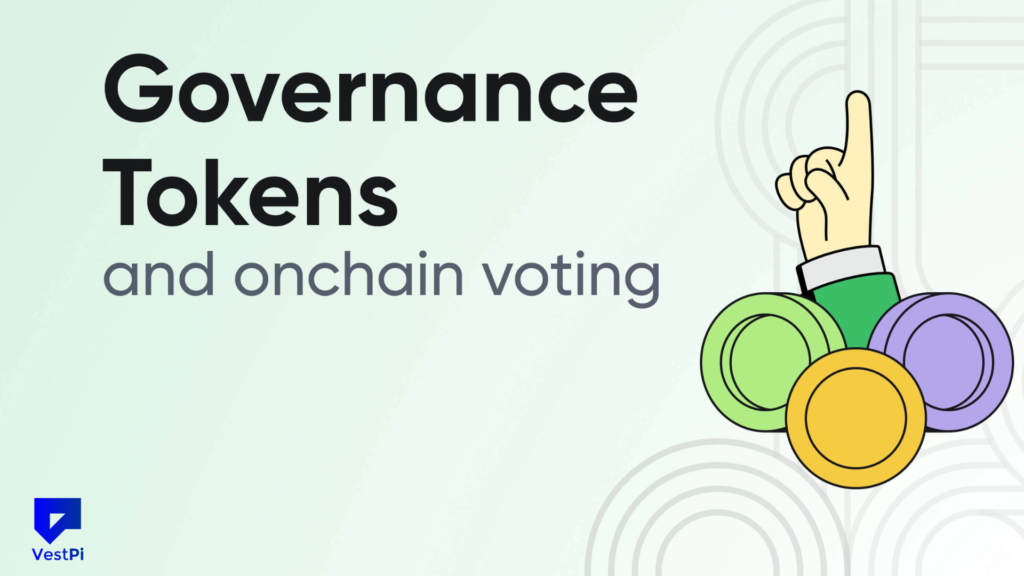
Governance Tokens Review
Governance tokens are cryptocurrencies that enable holders to influence a blockchain project’s decision-making process. They function as voting passes for on-chain projects. These tokens are commonly utilized in DeFi initiatives and DAOs.
The basic goal of governance tokens is to decentralize decision-making and offer holders a say in how the project is managed. Each governance token a person owns often translates to one vote on upcoming proposals, however there are alternative methods.
People who own governance tokens can use them to accept or reject changes to a decentralized app (dApp) or blockchain during periodic voting sessions. Many dApps also allow users to establish and champion initiatives using their governance tokens to put them up for a vote.
The Role of Governance Tokens in Blockchain Governance
Blockchain governance refers to the actions and procedures used to obtain agreements and make changes in a cryptocurrency project. Governance tokens were created to make the decision-making process easier.
They are utilized for both on-chain and off-chain governance. On-chain governance takes place directly on a project’s blockchain, such as voting on ideas using governance tokens. Off-chain governance refers to informal or formal conversations that do not take place on the crypto project’s blockchain.
Why Governance Tokens Matter in DeFi
DeFi, or decentralized finance, refers to financial apps that use blockchain technology instead of centralized intermediaries. Because there is no central authority, users help to define the rules. Governance tokens let a community to vote on issues such as:
- Interest settings: Interest settings determine how incentives and borrowing costs are computed.
- What can be used as collateral: Collateral refers to an asset used to secure a loan, analogous to a deposit for borrowing equipment.
- Trusted price data (oracles): Oracles, or trusted pricing data, bring prices from outside the blockchain into the app, similar to a live scoreboard. If the scoreboard is incorrect, the game makes poor decisions, hence picking trustworthy oracles is critical.
DeFi projects may continue to be transparent and community-driven because no one party has influence over these choices. The blockchain automatically enforces the regulations, which are encoded in code.
How Governance Tokens Work
Token-based voting is used in the majority of projects; the more tokens you own, the more votes you can cast. Delegation, which allows you to give your voting authority to a reliable, engaged community member who reviews proposals and casts your vote on your behalf (you may take it back at any time), is supported by many DAOs in order to accommodate busy users.
In order to prevent a few whales from easily overwhelming everyone, several projects test fair-balance voting, also known as quadratic voting, which restricts the rate at which voting power increases for very big holdings.
A DeFi initiative will create governance tokens on a smart contract blockchain if it wishes to do so. Each dApp will have its own governance token issuance policy, which ought to be documented both online and in a whitepaper.
DeFi protocols frequently reserve a portion of their governance tokens for community members to spend as incentives. These governance tokens are frequently given to users that donate cryptocurrency to a dApp’s liquidity pools in exchange for their services.
DeFi sites usually offer a governance interface with pending and active proposals for voting using these tokens.
In order to vote on a proposal, users will only need to connect their crypto wallet and enter the quantity of tokens they want. A person’s power over the outcome increases with the number of tokens they add to a proposal’s smart contract.
What are the Benefits of Governance Tokens?
There are many benefits users can gain from holding and using governance tokens.
1. Alignment of Interests
The interests of executives and community members are frequently out of alignment as a result of centralized governance arrangements. The interests of all parties involved are better aligned thanks to governance tokens.
2. Collaboration Opportunities
Voting facilitates dialogue, and dialogue fosters cooperation. Token holders are encouraged to work with other community members when a proposal is made, and voting decisions can be reached through discussion.
3. Decentralization
Decentralized governance is made possible in large part by governance tokens. Without it, DeFi projects would merely be smart contracts with no one to guide them, so the “De” in DeFi would scarcely make sense.
4. Fairness
By allowing each token holder to submit a proposal for the community to vote on, governance tokens contribute to the creation of a more equitable platform for decision-making. The community is also made aware of the specifics of each proposal and vote.
5. Involved Communities
Holders of governance tokens are more likely to participate actively since they have direct control over how a project develops.
What are the Drawbacks of Governance Tokens?
Although it’s obvious that governance tokens have numerous benefits, it’s important to be aware that they also have a number of drawbacks.
1. Lack of Accountability
Governance tokens have little accountability because they engage the whole community, the majority of whose identities are pseudonymous. Users will constantly point the finger at an invisible majority when a decision goes wrong, making it challenging to identify the culprit.
2. Malicious Intent
Additionally, there may be negative actors in the community who utilize their voting rights to support actions that benefit them personally rather than the community as a whole.
3. Uncertainty
A decision made by the majority does not always indicate that it is the best one for the project in the long run.
4. Voting Power of Whales
Investors who possess a significant amount of a certain token are known as whales. This implies that they also have a significant degree of voting power in terms of governance. This can be problematic because decentralization is the primary goal of DAOs and DeFi.
Difference Between Governance and Utility Tokens
Within blockchain ecosystems, utility tokens and governance tokens have distinct functions.
Governance tokens allow holders to participate in decision-making. They offer voting privileges and enable users to participate in the project’s governance process, such as submitting modifications or voting on upgrades.
Utility tokens are intended to grant consumers access to a good or service. They could be used to obtain discounts within an application, access platform features, or pay transaction costs.
Depending on how the project is set up, some tokens serve as both utility and governance tokens. The community guidelines and underlying code of the project define each use case. See Ethereum’s developer documentation for popular token standards, like ERC-20 fungible tokens.
Challenges of Governance Tokens
Large holdings, sometimes known as whales, can influence outcomes. However, many people do not vote due to time constraints and a tiny network price, known as gas.
Weak rules, such as imprecise thresholds, no waiting period, or weak management over the treasury, can also lead to difficulties. Strong projects adopt plain-English rules, provide reports, and use protections to reduce abuse.
How to Vote in a DAO Using Governance Tokens
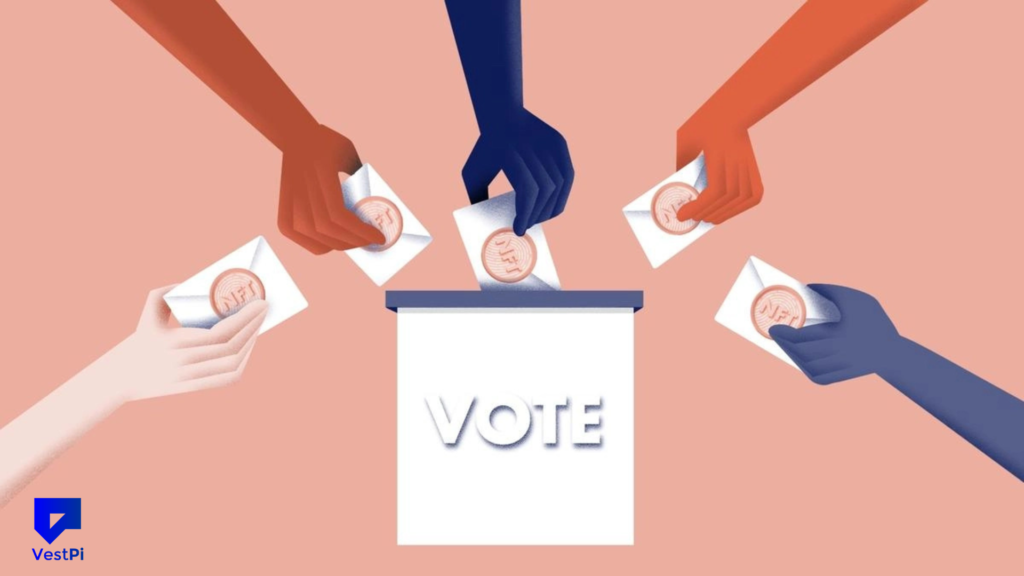
Every decentralized organization has somewhat varied governance guidelines. We’ll discuss an example from Arbitrum below, but since every network and organization takes a different method, it’s crucial to spend some time researching and going over the particular procedure for each DAO or protocol you intend to invest in.
Voting on Arbitrum
ARB token holders can vote with their own tokens or delegate votes to others.
To propose a new concept, please submit it in the Arbitrum DAO governance forum for discussion.
Submit your proposal for a ‘temperature check’ with Snapshot, an offchain poll to gauge interest. This stage requires 500,000 ARB.
If your idea passes the temperature check, use Tally to submit a formal proposal for a onchain vote. There is a 1,000,000 ARB barrier for this.
If your onchain vote is successful, the smart contracts will take action on the proposition. If you do not have enough ARB in your wallet to submit a proposal, other users may delegate tokens to you so that the proposal can be made.
How to Participate
To participate, create a wallet (app or device) to store your tokens and private keys (passwords). To ensure basic safety, avoid signing transactions you don’t understand and use a tiny governance wallet for voting, while keeping most assets in a hardware wallet.
To get engaged, go to the project’s forum and governance page to see current proposals. Learn the history by skimming through previous votes and audits.
To vote, read the complete proposal, follow links to code, and view results on a blockchain explorer (a public website that displays transactions). If you’re short on time, delegate voting to someone who provides explicit reasons.
Summary
Governance tokens are the foundation of decentralization itself. Governance forums are filled with analysis, discussion, and suggestions for enhancing and growing the project’s value. These tokens radically shift the power structure of decision-making, deepen community engagement, and allow protocols to adapt faster and address critical issues more swiftly.
Governance tokens turn users into participants. Communities can direct renovations, finances, and risk management in the open by adopting explicit regulations, keeping public records, and including voters or delegates.
Governance tokens have already proven their worth. They will most certainly be a major part of the industry’s evolution, with their value and usefulness increasing as DAOs and DeFi become more widely used.