
Yield farming has emerged as a key component of the DeFi revolution, allowing intelligent investors to generate passive income by properly deploying their cryptocurrency assets. However, as with any high-reward opportunity, it is not without danger.
Here, we’ve covered everything you need to know about yield farming in this guide, from the fundamentals to sophisticated tactics and how to manage the associated dangers.
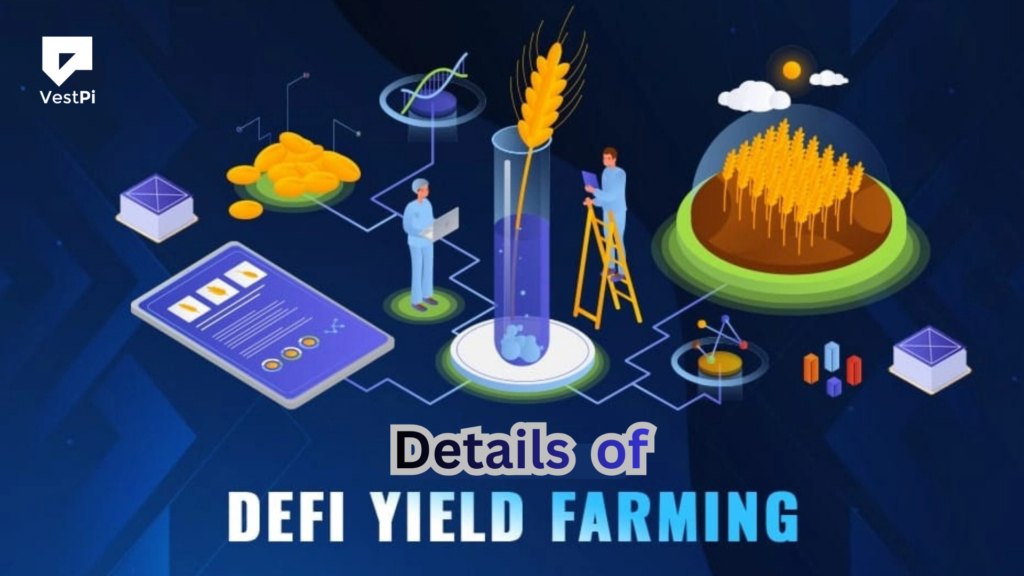
What Is Yield Farming?
Yield farming is a DeFi investing technique in which investors stake, lend, or lock up cryptocurrency assets to receive a return on investment (ROI) from their holdings. Because of its volatility, it is classified as a high-risk investment.
Typically, these returns take the form of transaction fees, governance incentives, or other cryptocurrency assets. Yield farming’s fundamental goal is to increase the liquidity available in DeFi protocols so that DEXs and other platforms can operate effectively.
DeFi runs on decentralized principles and uses smart contracts—self-executing pieces of code—to automate transactions, in contrast to traditional banking, where institutions control the flow of money. The DeFi industry has grown significantly as a result of this decentralized strategy.
Based on reports on DeFiLlama, the total value locked (TVL) in DeFi protocols has varied greatly. It increased from just $600 million in 2020 to almost $170 billion in November 2021 and is currently at about $107 billion. These numbers demonstrate the amount of capital entering DeFi in search of those high payouts.
Roles in Yield Farming
Yield farming involves several players collaborating through a decentralized system, with each playing a vital role in the ecosystem to guarantee that all financial operations function properly.
1. Liquidity Providers (LPs)
In order to facilitate decentralized trading for users of platforms such as Uniswap, LPs deposit token pairs into liquidity pools. To enable traders to buy and sell UNI and USDC, for instance, a user might deposit $1000 of the stablecoin USDC and $1000 of a selected token (like UNI).
A part of the trading fees made by customers exchanging tokens is given to LPs in exchange, and some platforms even provide extra tokens, such as governance tokens like veCAKE on PancakeSwap.
2. Lenders
By putting their assets into lending systems like Aave or Compound, yield farmers can act as lenders, enabling borrowing and interest payments on loans. Reviewing the interest rate is crucial, though, since supply and demand can cause it to change significantly.
3. Stakers
Staking is the technique of locking up tokens for predetermined amounts of time or flexibly in order to sustain a liquidity pool or blockchain network. “Stakers” are individuals who stake their tokens and receive rewards according to the quantity and length of their stake.
4. Borrowers
In order to get loans in a different token, borrowers pledge their cryptocurrency holdings as collateral, which enables them to leverage their assets for more yield farming options.
However, borrowers must carefully manage their collateral to prevent liquidation, which could result in the loss of their assets; therefore, this process carries a substantial risk.
How Does Yield Farming Work?
Yield farming is fundamentally driven by smart contracts that automate lending, borrowing, and liquidity provision.
- Liquidity Provision: On a DEX or lending platform, users deposit token pairs (such as ETH/USDT) into a liquidity pool. The trading of those assets is subsequently made possible by this pool, and users are given LP tokens that reflect their portion of the pool.
- Rewards System: LPs receive a portion of gas fees or governance tokens in exchange for supplying liquidity on the DEX or lending platform of their choice. For instance, according to their portion of the pool, they would get 0.3% of all transaction fees.
- Compounding Strategies: To optimize returns, some yield farmers reinvest the tokens they have earned; this is referred to as a compounding technique. To guarantee the best compounding of the investment, this typical technique is carried out either manually or automatically using yield aggregators.
Common DeFi Yield Farming Strategies
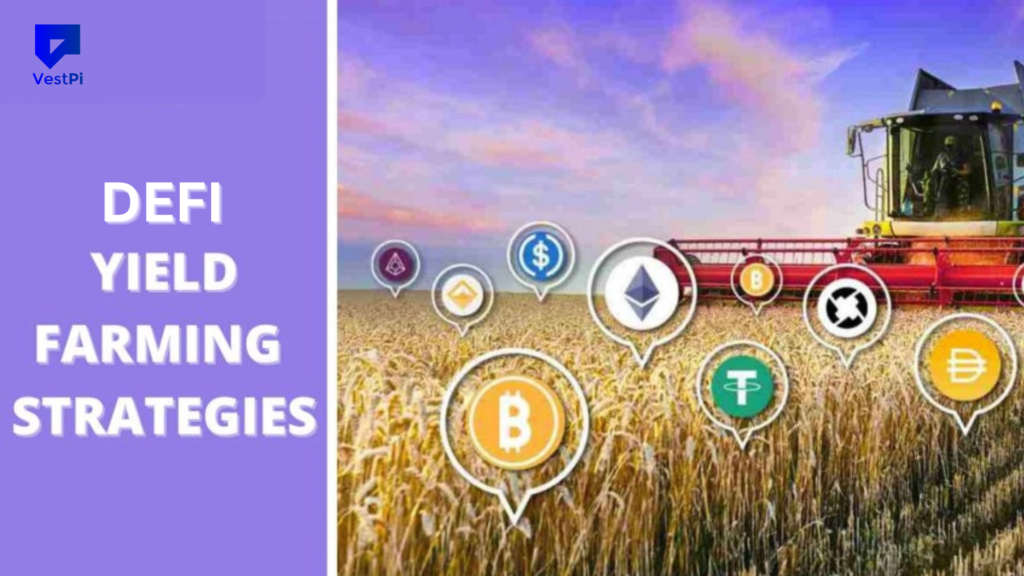
- Lending and Borrowing: Users can borrow against their assets as collateral or lend them for interest using platforms like Aave and Compound; borrowers frequently reinvest the money they borrow to take advantage of higher-yield opportunities. They will be more vulnerable to liquidation risks as a result.
- Liquidity Mining: Liquidity mining is the process of putting liquidity into the platforms’ related pools in order to earn platform-native tokens, such as UNI on Uniswap. These tokens enable users to take part in decision-making processes and grant governance powers.
- Staking: Depending on their stake and duration of staking, users who stake assets in staking pools or through a particular blockchain network receive an annual percentage yield (APY). While several centralized exchanges, including Binance and Kraken, permit users to stake, the majority of DEXs do not.
Summary
Yield farming is a high-risk DeFi investment strategy where investors stake, lend, or lock up cryptocurrency to earn passive income. Rewards come from transaction fees, governance tokens, or interest, and are earned by liquidity providers, lenders, stakers, and borrowers.
It operates through smart contracts, automating liquidity provision, lending, and borrowing. Common strategies include lending and borrowing on platforms like Aave, liquidity mining on DEXs, and staking tokens for returns. While lucrative, it carries significant risks, including exposure to liquidation and market volatility.