The operation of the blockchain and web3 ecosystem depends particularly on decentralized oracle networks. They let blockchain technology have practical applications by bridging the gap between the on-chain and off-chain worlds.
This post looks at the top blockchain oracles, with an emphasis on innovative solutions that are defining the decentralized future.
What Is a Decentralized Oracle Network?
In a nutshell, a Decentralized Oracle Network is an advanced blockchain oracle structure which employs a network of nodes to retrieve, validate, and distribute data from several sources, in contrast to conventional oracles that depend on a single source. The security, dependability, and credibility of the data utilized by smart contracts are improved by this decentralized method.
Before data is entered into the blockchain, a DON’s several independent nodes collaborate to gather and verify it. This procedure lowers the possibility of data manipulation, errors, and single points of failure—all of which are serious issues in decentralized settings.
DONs are especially helpful for complex contracts that need data from various sources, such as pricing feeds for decentralized finance (DeFi) applications or weather data for crop insurance.
How Does a Decentralized Oracle Protocol Work?
To provide safe and dependable data transfer to the blockchain, a decentralized oracle protocol follows these steps:
- Data Request: A smart contract asks for information like the weather or stock price.
- Node Selection: To retrieve the data, the protocol chooses a collection of independent nodes.
- Data Retrieval: Every node obtains data from the external sources it has been assigned.
- Data Validation: Nodes then use consensus processes to validate and aggregate the data.
- Data Delivery: The smart contract receives the combined data.
- Settlement & Rewards: The network’s native coin is frequently used to compensate nodes for their contributions.
Role of Blockchain Oracles in Web3
Decentralized oracle networks are essential for improving trust and security. Decentralized oracles in the web3 ecosystem provide important benefits that improve the growth and functionality of dApps, such as:
- Enhanced Security and Trust: By offering safe access to external data, decentralized oracles greatly lower the risks related to data manipulation and single points of failure, strengthening the security and dependability of dApps.
- Real-World Data Integration: They enable smart contracts to communicate with and react to real-world events and information, which is crucial for a variety of dApps. They do this by bridging the crucial gap between smart contracts and off-chain data.
- Enhanced Data Reliability and Accuracy: These oracles guarantee the accuracy and dependability of the data input into smart contracts by combining data from several sources, which is essential for applications in industries like supply chain management, insurance, and DeFi.
- Enhanced Flexibility and Interoperability: Decentralized oracles improve the overall flexibility and interoperability in the web3 space by offering customization options for different dApp requirements and cross-chain functionality for smooth information exchange across various blockchain networks.
- Transparency and Community Governance: On the blockchain, decentralized oracles’ operations are auditable and transparent. Furthermore, a lot of networks adopt community governance, which promotes a user-centered and self-sustaining ecosystem by enabling democratic decision-making and aligning incentives through tokenization.
Top 5 Decentralized Oracle Networks
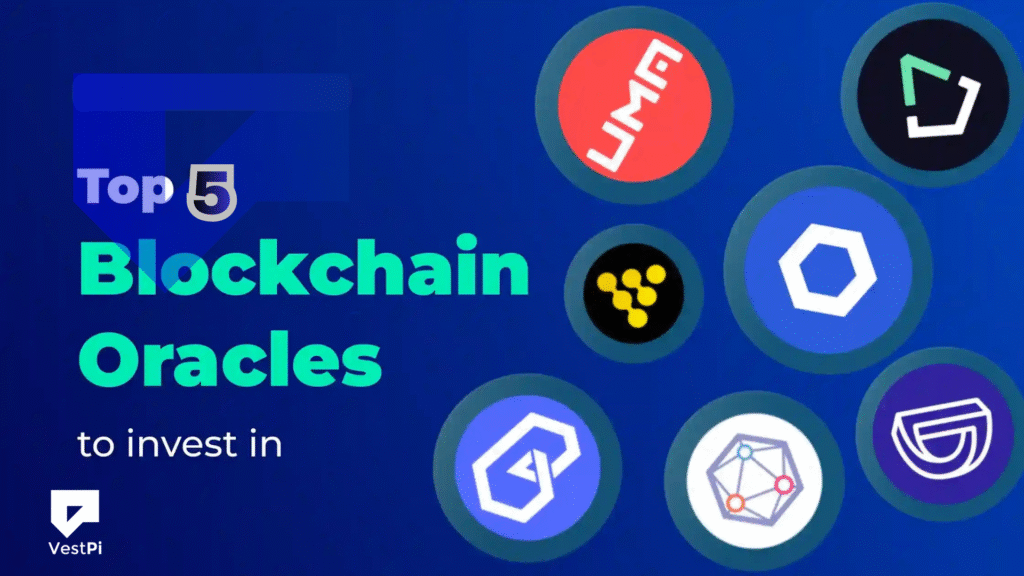
Here, the following decentralized oracles deliver unique strengths to the blockchain ecosystem, handling diverse needs and applications.
1. RedStone
RedStone is the first modular blockchain oracle with push and pull models that can give data in less than 2.4 milliseconds. The company became the fastest-growing oracle service by scaling from its first DeFi integration in early 2023 to $9 billion Total Value Secured by September 2025.
Moreover, more than 170 teams from more than 110 chains selected RedStone as their oracle provider because of its highest reliability standards and innovative innovations in LRT feeds, yield-bearing stablecoin feeds, Bitcoin PoR oracles, and RWA tokenization feeds.
By acquiring Credora’s DeFi ratings platform, RedStone establishes a vertically integrated blockchain data ecosystem that goes beyond oracle services to provide thorough DeFi market intelligence.
Furthermore, RedStone’s position as the official oracle provider for significant tokenized assets, such as BlackRock BUIDL, Apollo ACRED, VanEck VBILL, and Hamilton Lane SCOPE, exemplifies this integrated approach and positions the company to provide RWA data feeds, intelligence, and ratings for the convergence of RWA and on-chain finance.
2. Pyth Network
Pyth Network specializes in supplying blockchain applications with high-fidelity financial market data, including asset prices. The Pyth Network uses the PYTH token to compensate data producers for providing accurate real-world data.
Pyth Network primarily focuses on financial market data, aggregating data from several premium data suppliers and making it available on-chain. High-frequency updates, an emphasis on financial market data, and collaborations with reputable data sources are some of Pyth Network’s main advantages.
Pyth Network is in a strong position to be a major supplier of financial data for blockchain applications, given the increasing interest in DeFi. The Pyth Network is well-positioned for future acceptance and expansion thanks to its partnerships with top financial institutions and focus on real-time market data.
3. Band Protocol
Band Protocol, which emphasizes scalability and adaptability, provides a decentralized data oracle by making data accessible on-chain. It ensures quick and precise data transmission by using a delegated proof of stake approach for its network of Oracle nodes. In order to participate in the network and secure data feeds, validators must stake BAND tokens, which are then paid appropriately. The BAND token also functions as a security and governance tool.
Band Protocol’s cross-chain data exchange, adaptable oracle scripts, and emphasis on scalability set it apart from other blockchain oracles. Band Protocol is a leading blockchain oracle network because of its adaptability to various blockchain contexts and community-driven methodology, which augur well for its future growth and uptake.
4. API3
API3 provides a more direct way to data feeds by integrating the blockchain with conventional APIs. It makes it possible for API providers to run their own nodes, sending data straight to the blockchain without the need for intermediaries. The API3 ecosystem uses $API3 tokens for governance, enabling token holders to control the decentralized APIs and the project’s course by voting on proposals.
A direct API-to-smart-contract interface, decentralized governance, and an emphasis on lowering dependency on third-party intermediaries are some of the distinctive characteristics of the API3 Oracle network. API3 is positioned as a promising competitor in the changing oracle landscape thanks to its creative approach to decentralized oracles and its potential to bring traditional data on-chain.
5. Flare Network
The goal of Flare Network is to make data transit between blockchains and the internet safe and scalable. It offers a special combination of speed and security by integrating Ethereum’s smart contracts with the Avalanche consensus protocol.
The Flare Network uses the FLR token as collateral for the trustless issuance and redemption of assets in its ecosystem and for governance reasons, allowing holders to participate in network decisions.
The incorporation of Ethereum smart contracts, emphasis on scalability and interoperability, and support for non-Turing complete tokens like XRP are some of Flare Network’s distinctive features.
Notable Oracle Innovations
Even though RedStone and Pyth Network account for a large portion of the discussion, a number of other Oracle solutions are progressing the space:
- Chainlink: As of late 2023, Chainlink had facilitated transactions worth over $9 trillion. In order to maximize security and dependability, its strong network of independent nodes uses decentralized computation and aggregation to obtain, validate, and distribute data to smart contracts.
- UMA: Offers reliable oracles for financial contracts and derivatives, concentrating on synthetic assets and prediction markets.
- DIA: An open-source Oracle project that facilitates customized data feeds for certain use cases by combining data from centralized and decentralized exchanges. Check out Kanga Exchange’s overview of the best blockchain oracles for more reading.
Current Trends and What to Watch
The landscape of oracles is always changing. As tokenization of real-world assets, games, and DeFi spreads, oracles are anticipated to:
- Use confidential computing and zero-knowledge proofs to improve security and privacy.
- Increase cross-chain and multi-chain interoperability.
- Develop community-driven, decentralized governance to counteract the dangers of centralization.
The future of decentralized Oracle networks will also be significantly shaped by enterprise adoption and regulatory clarity.
Bottom Line
Blockchain oracles have been the unsung heroes who have enabled an explosion of real-world use cases for smart contracts.
As the ecosystem evolves, developers, investors, and users must be aware of the strengths, limits, and most recent advances of solutions such as RedStone, Pyth Network, and their competitors.
Moreso, combining respected Oracle services with a trusted hardware wallet provides a secure way to participate in DeFi and Web3.