
The Idea of Restaking crypto aims to maximise capital efficiency. With this, users can stake the same tokens on different blockchains and protocols, safeguarding many networks at once. This method may result in greater pay for customers for securing more protocols, along with increased risk reduction.

Restaking is a method of managing resources for staking that are not controlled by a central body. Some protocols in this sector may employ a type of liquid staking, which entails producing a token that represents a staked asset, to extract additional value from staked tokens in a way that benefits stakers, other networks, and the restaking protocol itself. That said, users can improve their total Return on Investment by optimising asset utilisation through restaking.
How Restaking Works
Restaking allows users to secure several networks with the same money. There are various restaking possibilities available:
- Native restaking: This is only available to validator node operators. Validators who want to commit their configuration to a restaking program will need to download and install additional node software for the restaking module.
- Liquid restaking is a sort of liquid staking in which a staker stakes their assets with a validator and receives a token representing their stake. The staker then stakes the token on the restaking protocol.
Benefits of Restaking
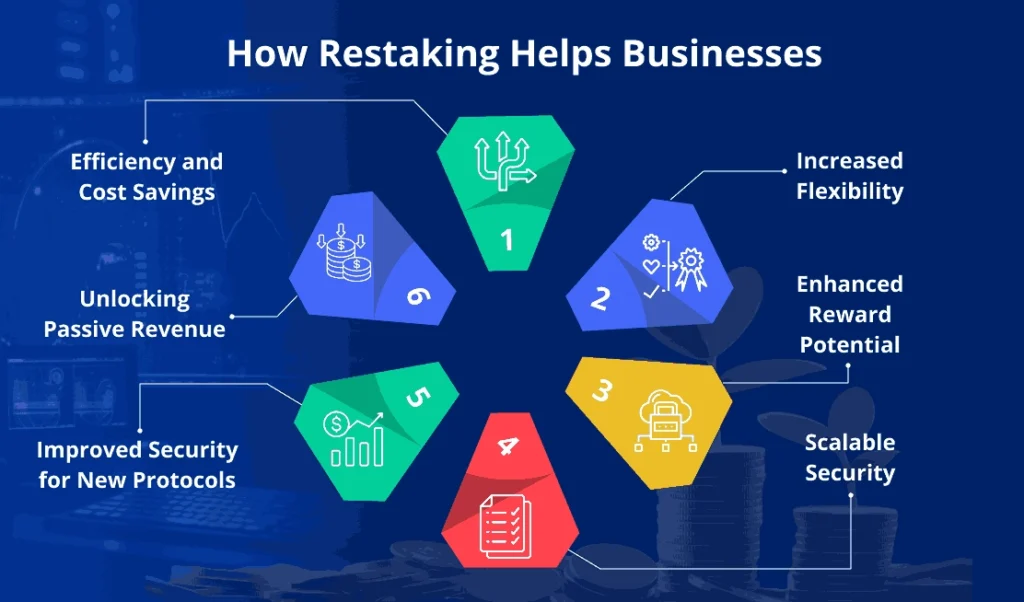
Restaking has various benefits that can greatly influence a user’s investment approach. The key benefit is capital efficiency, which enables users to collect rewards from multiple sources without having to liquidate their assets.
Furthermore, restaking encourages more liquidity in the market, which can help stabilise token values and improve overall market health. Users can also diversify their income streams to reduce dependency on a single source of revenue. This diversification is especially tempting in the volatile cryptocurrency market, where having numerous income sources can help mitigate downturns. Here is what restaking does in brief:
- Restaking enables assets to be used in a variety of decentralised applications.
- Users can win a variety of prizes from their staked tokens.
- The technique promotes more people to participate in staking.
- It boosts market liquidity by making assets more efficient.
- Restaking improves the overall security of the blockchain network.
- Token prices remain stable as liquidity improves.
- Increased capital efficiency through simultaneous staking and utilisation.
- Increased liquidity improves the entire ecosystem.
- Diversification of income streams for investors.
The Mechanism Behind Restaking
Restaking works through smart contracts, which allow users to lock their assets so that they can be used across several platforms. This novel strategy ensures that assets are secure while also being productive in many ecosystems.
The smart contracts allow for smooth transitions between staking and using the assets for other purposes, like as lending or liquidity provision. The technology underpinning restaking reduces risks while increasing possible profits for users. This flexibility is a major feature that distinguishes restaking from standard staking methods.
- Smart contracts automate the restaking process.
- Assets stay safe while producing additional yield.
- Users can interact with several DeFi items at once.
- The technology reduces hazards via decentralised protocols.
- This flexibility increases total profits for participants.
Challenges and Risks of Restaking
While restaking has many advantages, it is not without problems and risks. Users must be mindful of the difficulties that come with managing numerous staking positions, as well as the possibility of smart contract vulnerabilities.
The decentralised nature of these protocols implies that users are responsible for their own security, which might be intimidating for novices. Furthermore, the yield achieved by restaking might vary greatly depending on market conditions and the precise techniques used. Understanding these possible hazards below is critical for anyone who wishes to engage in restaking effectively.
- Complexity in handling multiple stakeholder positions.
- Potential flaws with smart contracts.
- Users are responsible for their own security.
- Variable yields are affected by market dynamics.
- Before participation, you must conduct thorough research.
Future of Restaking in Crypto

The future of restaking is bright as more projects use this technique to improve capital efficiency. As the DeFi environment evolves, we can expect more advancements to streamline the restaking process and improve the user experience.
Increased awareness and comprehension of restaking is expected to lead to greater adoption among crypto investors. Furthermore, advances in technology and security measures will help to reduce existing hazards, making restaking a more appealing alternative. Overall, restaking is expected to play an important role in the future of decentralised finance through:
- Continued innovation in the DeFi space which will improve restaking.
- Broader adoption as users become more aware of its benefits.
- Technological developments which will reduce current threats.
- An improved user experience which will entice more participants.
- Restaking is likely to lead to new investment techniques.
Blockchain security architecture is divided into two categories: Proof of Work (PoW) and Proof of Stake (PoS). In PoS networks, people contribute money to the network’s security. This practice is known as staking.
Stakers secure their assets with validator nodes on the network. The network’s security level is determined by the number of active validators, the proportion of staked tokens, and the distribution of tokens among validators.
Restaking methods have arisen to put staked tokens to work, with the goal of increasing their utility. This method tries to improve the utility of the staked asset and may result in higher remuneration for the holder, however with increased slashing risks.
Wrapping Up
Restaking in cryptocurrency is a novel strategy that improves capital efficiency for investors. Restaking maximises potential benefits by allowing staked assets to be used in different ways, while also encouraging increased liquidity and engagement within the DeFi ecosystem.
While there are certain problems, restaking has considerable benefits and can lead to more sustainable investment methods. As the crypto landscape continues to evolve, understanding and leveraging restaking will become increasingly important for investors seeking to optimize their portfolios. Accepting this unique technique may pave the way for a more efficient and satisfying crypto experience.