
Account Abstraction introduces smart contract capability into cryptocurrency wallets with the goal of enhancing user experience and overall security. We’ll learn more about what account abstraction is and why it’s so important to cryptocurrency in today’s article.
What is Account Abstraction?
In general, the capacity to keep control over a user’s money apart from the execution of smart contracts is referred to in blockchain as “account abstraction.” Put more simply, account abstraction is the capacity to handle money using smart contracts without needing customers to give the smart contract ownership over their money.
Account abstraction is a key idea in blockchain because it can significantly enhance user security and experience without giving up complete wallet access.
For example, MetaMask, a popular browser-based wallet, is an EOA. It does not have the ability to construct smart contracts; therefore, its use is limited to application interactions in which users give over control of their accounts. Contract accounts, on the other hand, have the ability to deploy smart contracts, which improves wallet functionality and personalization.
How Does Account Abstraction Work?
Account Abstraction involves several essential concepts, including UserOperation, Bundler, Sender, EntryPoint, Paymaster, and Aggregator. Let us learn how they work.
1. UserOperation
These are the user-initiated actions. They differ from regular transactions in three main ways:
- Additional fields: UserOperations introduces extra fields into the transaction structure, allowing for greater sophistication.
- Alternate mempool: This is one of the most significant aspects of AA wallets. Every transaction is transmitted to a different mempool. In this mempool, transactions are grouped together and included in a block.
- Authentication: Users can configure the authentication rules for their transactions.
Any user interaction can include numerous instructions and other data to carry out smart transactions.
2. Bundler
The bundler contract monitors the alternate mempool created for user operations. It chooses many UserOps from the mempool and groups them into a single transaction. The bundle is subsequently transferred to the EntryPoint contract.
As you can expect, bundlers are an important component of the entire AA infrastructure. They are compensated for each successful UserOp to encourage their facilitation of the process.
3. EntryPoint
In the AA system, the EntryPoint is a specific smart contract that serves as a central hub for handling user transactions. By collaborating with bundlers—network participants in charge of collecting and transmitting UserOps—it makes decentralized, account-based transactions possible.
Upon receiving a package, the EntryPoint begins by confirming each UserOp. Verification validates the operation’s legitimacy, including its signature and authorization, and makes sure the wallet has enough money to cover gas costs. The EntryPoint rejects the transaction if any wallet does not have enough money or does not pass verification.
After verification, the EntryPoint calls the wallet’s designated function to carry out the UserOp, taking money out of the wallet to reimburse the bundler for gas expenses.
4. Paymaster
The requirement for native tokens to cover gas costs is one of the primary issues with EOA wallets. For instance, in order to use the BEP20 network on Metamask, all transactions require BNB tokens. This problem is resolved by the Paymaster.
Gas payment policies are managed by the Paymaster contract. It enables developers to sponsor gas fees for users or permits users to pay gas fees in tokens other than the native token of the blockchain.
Additionally, Paymasters give developers the ability to incorporate unique validation logic or modules, giving apps the freedom to manage gas payments in various ways according to their unique needs.
5. Aggregator
By merging several user signatures into a single aggregated signature, an aggregator streamlines transaction processing. By allowing the bundled UserOperations to be checked collectively rather than individually, the Aggregator reduces gas expenses and speeds up processing.
Bundlers managing big transaction batches will find this extremely helpful.
Benefits of Account Abstraction
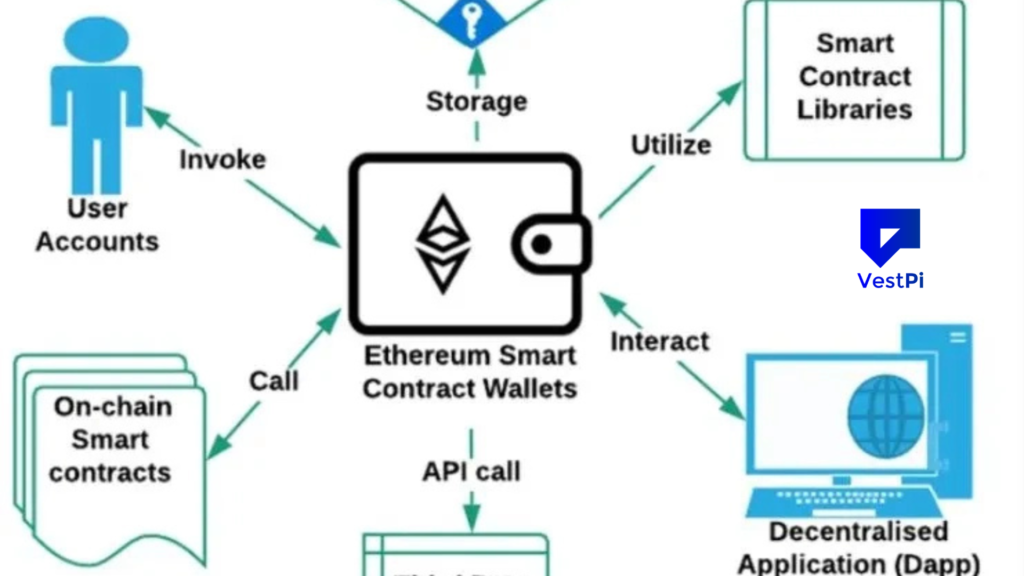
Account abstraction provides several benefits, including more flexible recovery, signature abstraction, roles and policies, and gas abstraction.
Account abstraction would allow users to define rules and dedicate wallet(s) to transfer funds if wallet activity has been dormant for more than one year (e.g., dead man’s switch). If a wallet owner died, the cash would be automatically transferred to a “beneficiary” rather than being lost forever.
Session keys are another example of how users can allow smart contracts to control their wallets from a specific address for a set length of time (for example, gaming).
Another example is gas abstraction. Users could pay for gas in any ERC-20 token (for example, DOGE) rather than ETH, which requires a continual ETH balance. Users can also batch transactions to save money on petrol.
Account abstraction provides a transformational set of benefits for the Web3 ecosystem. Here are some other key benefits:
1. Enhanced Security
Account abstraction enhances account security by supporting multi-signature requirements and configurable verification procedures. By lowering the need for private keys and enabling two-factor authentication, biometrics, and time-based permissions, it lowers the possibility of theft or unwanted access.
2. User-Friendly Onboarding
Meta transactions reduce the requirement for users to initially own native blockchain coins, simplifying onboarding and lowering entry barriers to interacting with dApps.
3. Cost Efficiency
Integrating several activities into a single transaction, lowering gas costs, and increasing the cost-effectiveness of complicated procedures like de fi tactics or in-game actions.
4. Elimination of Seed Phrases
Account abstraction lowers the danger of loss or compromise by substituting more secure methods, such as biometrics and two-factor authentication, for seed phrases.
5. Shared Accounts and Multi-User Operations
Enhances collaboration and security for both individuals and enterprises by supporting user permissions and multi-signature wallets, enabling shared accounts and restricted access controls.
6. Interoperability
Easily integrate across blockchains thanks to compatibility with Ethereum Virtual Machine (EVM) chains like BNB Chain, Ethereum, Polygon, Avalanche, and Arbitrum.
Why Account Abstraction Matters?
The capabilities of EOAs include limits that do not necessarily promote or nurture adoption among the next wave of users. Private key management is difficult, and some users prefer not to be responsible for securing their keys.
The alleged benefits of custodial or non-custodial wallets revolve around the security of the wallet’s private key. Are most people technically competent enough to protect their private keys? Is it better for a custodian to handle a user’s private key?
The motto “not your keys, not your wallet” is true since the owner of a private key has complete control over a wallet. For example, if you lose your private key, which is not kept or recorded anywhere, you will be unable to reclaim the money held in that wallet.
Furthermore, EOAs lack access control granularity. This means that you cannot establish spending policies or regulations and must have an ETH balance to conduct transactions.
Let’s assume you’re particularly concerned about wallet security and only want to transact $25 or less on any given day, or you want to set up automatic payments for a monthly newspaper subscription. These instances are now inaccessible under typical EOAs, but account abstraction offers a viable alternative.
Final Thoughts — VestPi Perspective
Account abstraction is not a feature enhancement; rather, it represents a fundamental shift in how cryptocurrency wallets operate.
Account abstraction eliminates some of the most significant barriers to Web3 adoption by offering wallet-level programmability, recoverability, and usability.
The future of cryptocurrency wallets will be defined not by private keys, but by smart, user-centric account design. Account abstraction is how cryptocurrency gets there.